Top Heroku Alternatives in 2024
A year after Heroku sunsetted its free tier, finding a cost-effective and performant deployment solution remains crucial. With the free tier, Heroku provided an easy way to run containerized applications and managed databases on a unified platform.
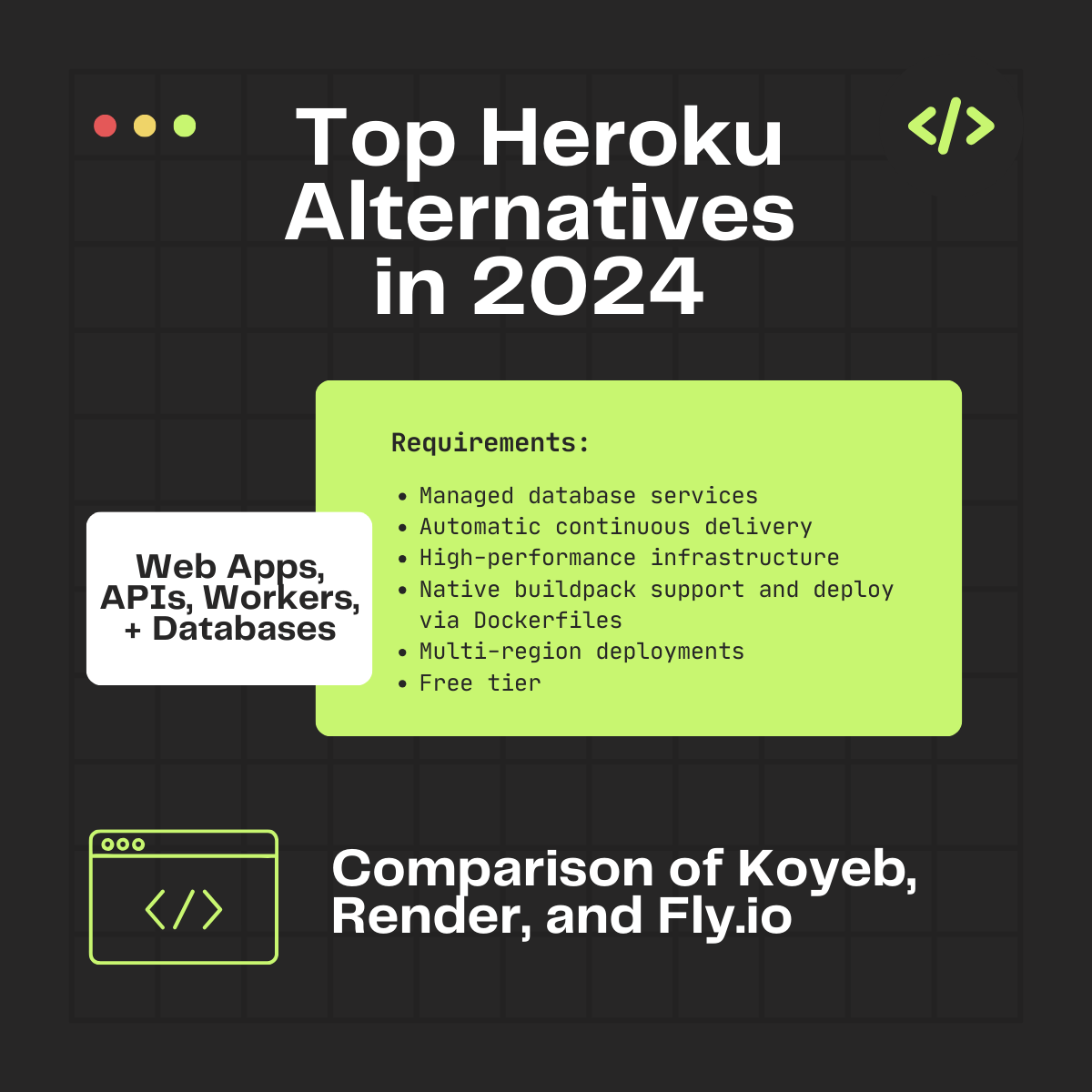
This comparison explores three of the best alternatives: Koyeb, Render, and Fly.io. Each has its own advantages for anyone seeking an easy-to-use platform to deploy their applications.
Following an individual overview of each Heroku alternative, there is a global comparison table to give you a quick way to compare the key differentiators. Here are the criteria we will dive into when exploring the best cloud platform for hosting your application:
Workloads supported — Not all platforms are built to support the same types of workloads. It is important to find the right platform for your project.
Managed database services — Many applications require persistent storage. Managed database services provide the reliability and scalability your projects need.
Automatic continuous delivery — A continuous delivery pipeline allows you to seamlessly push changes to your code live in minutes. When a platform provides this pipeline, it is one less thing you have to build or maintain.
Built-in features — Native features for scaling, networking, collaborating, and more.
Infrastructure — Knowing where your applications are hosted is crucial. Choosing a platform running on bare metal not only provides optimal performance, it also frees you from limitations imposed by platforms running on top of another cloud service provider.
Locations available for multi-region deployments — Proximity matters. The closer your services are to your users, the lower the latency, resulting in a smoother user experience. Platforms offering deployment in multiple locations increase your chances of placing your applications near your audience.
Deployment speed — Every second counts. Deployment speed is what allows your code to go live and ensures your users get the latest and greatest without unnecessary delays.
Free Tier — A free tier is important when building a new project or testing a new product.
1. Koyeb
Koyeb is a serverless platform providing the fastest way to deploy full stack applications and databases globally. When searching for a Heroku alternative for git-driven and Docker deployments, Koyeb ticks all the boxes: free tier, managed databases, and automatic continuous deployments. The deployment experience feels very much like a Vercel for the backend.
Workloads supported: Full stack applications, web services, APIs, background workers, and databases.
Managed database services: Managed PostgreSQL.
Automatic continuous delivery: Git deployments benefit from automatic continuous deployments each time changes are pushed to the project’s repository.
Built-in features: Global edge acceleration and CDN for all workloads, global VPC, autoscaling, Dockerfile support, support for HTTP/2 + gRPC + websockets, automatic SSL (TLS), service mesh, service discovery, secrets management, real-time logs and metrics, custom domains, and more.
Infrastructure: The Koyeb platform runs directly on Equinix Metal bare metal machines.
Locations available for multi-region deployments: San Francisco (US), Washington, D.C. (US), Frankfurt (Germany), Paris (France), Singapore, and Tokyo (Japan). A global Anycast network sits in front of services, ensuring requests are routed to the nearest server.
Deployment speed: Creating a Koyeb account and deploying a first service can take just minutes. You can deploy using the control panel or CLI.
Free Tier: Koyeb’s Free Tier lets you run one service and one managed PostgreSQL database. Free Instances run for free for the full month. The first 100GB of outbound bandwidth per month is free. Additional details of the free resources are on Koyeb’s pricing page.
2. Render
Render is a platform built for web service and application deployment that is easy to use and scalable. Render is a viable Heroku alternative providing managed database services and automatic continuous delivery.
Workloads supported: Static sites, web services, background workers, and cron jobs.
Managed database services: Managed PostgreSQL and Redis.
Automatic continuous delivery: Render connects with GitHub to deploy your apps and websites automatically on every push to your project.
Built-in features: Autoscaling, DNS management, load balancing, static sites are backed by a global CDN, support for HTTP/2 and full TLS for web services, custom build packs, preview environments, and more.
Infrastructure: The Render platform runs on top of AWS.
Locations available for multi-region deployments: Oregon (US), Ohio (US), Frankfurt (Germany), and Singapore.
Deployment speed: Creating a Render account and deploying a first service can take just minutes. You can deploy using the control panel or CLI.
Free Tier: Render’s Free Instance lets you run a service for 750 hours in a month. Idle services spin down after 15 minutes of activity. More information is available in Render’s documentation.
3. Fly.io
Fly.io is a platform built to let you run Docker images worldwide. To deploy on Fly.io, you will need to containerize your application using Docker. The Fly.io platform runs on bare metal servers and runs workloads in Firecracker microVMs. In comparison to Heroku, continuous deployments are not built-in.
Workloads supported: Web services and applications, databases, background workers, and cron jobs.
Managed database services: Managed PostgreSQL.
Manual continuous delivery: You will need to manually configure a GitHub Actions to set up continuous deployment for your services running on Fly.io.
Built-in features: Global load balancing, zero-configuration Anycast network, autoscaling, scale to zero, SSO, MFA, SOC2.
Infrastructure: The Fly.io platform runs directly on Equinix Metal bare metal machines.
Locations available for multi-region deployments: Fly.io supports deployments in 35 regions. A global Anycast network sits in front of services, ensuring requests are routed to the nearest server.
Deployment speed: Fly.io offers fast deployment speeds. You can only deploy via the CLI.
Free Resources: Fly.io does not offer a free tier, but rather free resources: up to 3 shared-cpu-1x 256mb VMs, 3GB persistent volume storage, and 160GB outbound data transfer. More information is available in Fly.io’s documentation.
Heroku Alternative Comparison Table
Table comparing Koyeb, Render, and Fly.io
Fast Deployments Made Easy
Choosing the right deployment platform is crucial for any project. I’d love to hear about your experiences using these providers! What matters most to you when selecting a deployment platform? Performance, cost, ease of use? Let me know in a comment below. 😊
